French
  English
  Spanish
  Thai
Thai  Vietnamese
  Chinese
  Arabic
  Portuguese
  Hindi
Hindi  Nepali
  Italian
  Greek
Greek  Indonesian
  Tagalog
  Malay
Malay 
Pourquoi les politiques actuelles en matière de drogues sont-elles inefficaces envers les femmes, les travailleuses du sexe, les mères et les personnes de diverses identités de genre ?
Plaidoyer
Criminalisation
Stigmatisation et discrimination
Femmes qui consomment des drogues
20 février 2026

Le gouvernement australien a rouvert le Enquête sur les conséquences sanitaires de la consommation d'alcool et d'autres drogues en Australie. L'enquête, entamée lors de la session parlementaire précédente, a été interrompue avant son terme en raison des élections fédérales de mai 2025. Les observations d'AIVL lors de la précédente enquête sont reportées à la présente enquête.
AIVL en collaboration avec Alliance écarlate et nos organisations membres ont fourni des preuves supplémentaires en réponse à Document de travail.Notre dernier rapport démontre que la politique australienne actuelle en matière de drogues est préjudiciable aux femmes, aux travailleuses du sexe, aux mères et aux personnes de diverses identités de genre qui consomment des drogues, et compromet notre sécurité. Vous trouverez ci-dessous un résumé des principaux points soulevés dans ce rapport.
1. Genre et ‘ narcoféminisme ’
L’expérience des drogues, de la violence et du système de santé est fortement influencée par le genre. Les hommes ont plus facilement accès aux services de prise en charge des troubles liés à l’usage de substances psychoactives, comme les programmes d’échange de seringues ; or, on sait qu’ils sont confrontés à la stigmatisation, aux jugements et à des obstacles structurels lorsqu’ils font appel à ces services. Parallèlement, les femmes et les personnes de diverses identités de genre subissent souvent des formes accrues de punition, de surveillance, de stigmatisation et de contrôle lorsqu’elles interagissent avec les systèmes et les prestataires de services, ce qui reflète les dynamiques de genre qui façonnent l’accès aux soins et aux traitements dans le cadre des interventions en matière de troubles liés à l’usage de substances psychoactives. De plus, les femmes, les personnes de diverses identités de genre et les travailleuses et travailleurs du sexe qui consomment des drogues sont exclus des principales organisations et campagnes féministes.
Nous présentons ‘narcoféminisme’Nous avons proposé un cadre reconnaissant les méfaits des politiques en matière de drogues (tels que la criminalisation, le placement d'enfants et la violence) comme des enjeux féministes fondamentaux. Nous avons invité la commission d'enquête à prendre en compte le vécu de toutes les femmes consommatrices de drogues et à souligner les nombreuses raisons positives qui y sont associées : la sécurité, le lien social, le plaisir. Enfin, pour celles et ceux qui souhaitent modifier leur rapport aux drogues, les services doivent impérativement intégrer la dimension de genre dans ces expériences.
2. Les femmes toxicomanes : prises au piège entre la violence et un système qui les culpabilise
Les femmes qui consomment des drogues ont deux à cinq fois plus de risques d'être victimes de violences sexuelles, conjugales ou familiales. Pourtant, lorsqu'elles cherchent de l'aide, elles se voient souvent refuser l'accès au logement, aux soins de santé et aux services de lutte contre les violences sexuelles et familiales.
L'analyse du document, qui met l'accent sur l'alcool comme cause principale de violence, est erronée. Les faits montrent que l'alcool sert souvent d'excuse ou de facteur aggravant, et non de cause première. Les véritables enjeux sont les rapports de force et de contrôle liés au genre. Les femmes qui se défendent ou qui consomment des drogues sont souvent perçues comme des ‘ victimes indignes ’, ce qui perpétue la violence.
3. Mères et femmes enceintes : punies, non soutenues
Les mères toxicomanes vivent dans la peur. Demander de l'aide peut entraîner le retrait de leurs enfants. Cela les pousse à consommer des drogues de manière plus risquée (par exemple, seules) et à éviter les soins de santé. Ces obstacles peuvent les empêcher d'accéder aux programmes de traitement et de maintenance par agonistes opioïdes (pharmacothérapie). Les services doivent être adaptés aux familles et non punitifs afin de favoriser des résultats positifs en matière de santé et de préserver l'unité familiale.
4. Jeunes femmes et personnes de diverses identités de genre : naviguer entre risque et plaisir
Pour les jeunes, la consommation de drogues n'est pas qu'une question de risque : c'est aussi une manière de créer du lien, de prendre du plaisir et d'explorer son identité. Or, le harcèlement et les violences masculines dans les espaces sociaux influencent profondément nos comportements. Les stratégies de réduction des risques mises en place par les jeunes femmes et les personnes de diverses identités de genre visent à gérer les comportements masculins, et non pas seulement à être attentives à notre propre consommation. Les services et les campagnes de prévention doivent être conçus avec nous, et non pour nous.
5. Travailleuses du sexe consommatrices de drogues : stigmatisation accrue
Les travailleuses du sexe qui consomment des drogues sont confrontées à une double stigmatisation. Elles sont souvent exclues des services de santé et des services sociaux traditionnels. Elles ont besoin d'un soutien spécialisé, animé par leurs pairs, qui reconnaisse leurs besoins spécifiques et non de stéréotypes qui les culpabilisent ou remettent en question leurs choix.
6. Consommation de drogues à caractère sexuel : ce n'est pas seulement un truc de ‘ gays, bi+, queers ’
L’usage de drogues pour intensifier les rapports sexuels (‘ chemsex ’) est souvent présenté comme ne touchant que les personnes LGBTQ+. Or, de nouvelles données montrent qu’il est tout aussi répandu chez les Australiens non-LGBTQ+. L’information en santé publique doit être inclusive et axée sur le plaisir, le consentement et la sécurité. La promotion de la santé concernant les infections sexuellement transmissibles (IST) est plus efficace lorsqu’elle est menée par les pairs. Les réponses du système de santé pourraient être éclairées par les valeurs et les préférences des personnes qui consomment des drogues à des fins sexuelles. La recherche menée par les pairs doit être au cœur de nos préoccupations.
7. Les soins dentaires : un droit, pas un luxe
Les personnes toxicomanes peuvent souffrir de problèmes dentaires car les soins sont trop coûteux, les dentistes les jugent souvent et le système est complexe. Lorsque les gouvernements des États et territoires financent les services dentaires pour leurs administrés, on observe une forte utilisation de ces services. Une bonne santé bucco-dentaire est essentielle à notre santé globale et à notre qualité de vie. Nous avons besoin de soins dentaires abordables et respectueux pour tous, inclus dans le système de santé public.
8. Leçons tirées de la COVID-19 : les pairs sont essentiels aux réponses en matière de santé publique
La pandémie a particulièrement durement frappé les personnes toxicomanes. Les services ont fermé, les effectifs policiers se sont renforcés et les risques sanitaires ont explosé. Certaines mesures positives, comme un accès facilité aux médicaments, ont été mises en place, mais ont ensuite été annulées. Pour planifier les futures pandémies et les catastrophes liées au climat, telles que les inondations et les feux de brousse, nos communautés doivent être pleinement impliquées et contribuer à l'élaboration d'une réponse qui ne laisse personne de côté.
En résumé : un appel à l’humanité et aux droits
Les politiques australiennes en matière de drogues, punitives et uniformes, sont néfastes. Il est impératif de privilégier la réduction des risques, les services d'entraide et le respect des droits humains. Bien que l'enquête puisse formuler des recommandations de réforme soumises à l'approbation du gouvernement, la prochaine mise à jour de la Stratégie nationale de lutte contre la drogue sera l'occasion idéale de prendre en compte l'expérience concrète des personnes concernées.
Notre dossier comprend plus de 30 recommandations concrètes. Vous pouvez télécharger la version complète ci-dessous.
Rédigé par Joël M., spécialiste des politiques et de l'évaluation chez AIVL
Note sur l'utilisation de l'intelligence artificielle : Joël a utilisé DeepSeek-V3, un modèle de langage de type « mixte d'experts », pour suggérer des résumés à partir de la proposition initiale d'AIVL. Ces résumés ont ensuite été restructurés et corrigés.
Lire la soumission complète
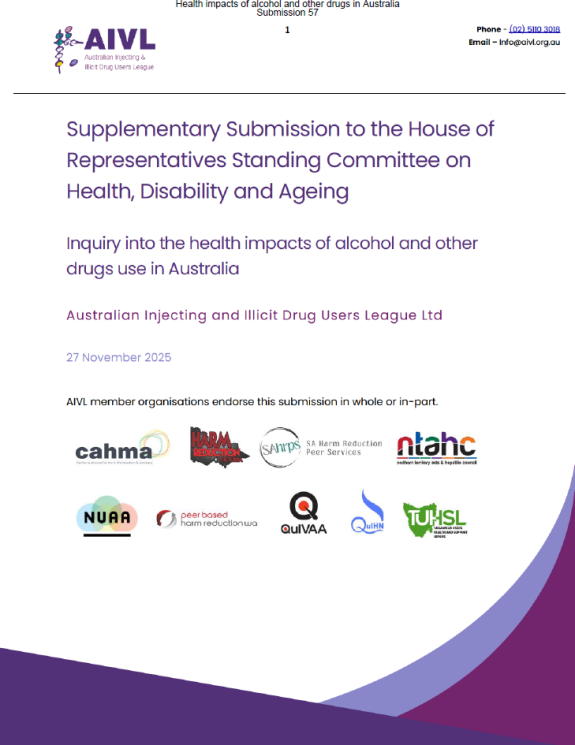
Enquête sur les conséquences sanitaires de la consommation d'alcool et d'autres drogues en Australie
Télécharger